
Office of Continuing Medical Education
Continuing Medical Education Certification
The University of Tennessee Health Science Center College of Medicine (UTHSC COM) is accredited by the Accreditation Council for Continuing Medical Education (ACCME) to provide continuing Medical Education for physicians. The Office of Continuing Medical Education (CME) is charged with the management of the ACCME accreditation for the Knoxville campus.
All ACCME-certified activities are expected to be planned, implemented, and evaluated in compliance with the:
New to Continuing Education Planning? Start Here:
- 4 Tips for Planning a CE Session
- 5 Tips for Creating an Interactive CE Session
- Tips for Integrating IDEA Principles into CE Planning
- 5 Tips For Evaluating a CE Session
- The Complete ACCME's CE Educator's Toolkit
.
Initial Planning and Requirements
STEP 1:
Contact us:
- Email us to ensure staff availability for your conference dates.
- It is important to involve the staff of the CME early in the planning process of a continuing medical education activity.
STEP 2:
Complete our Continuing Medical Education Application for AMA PRA Category 1 Credit™.
Please Note: Applications must be complete and submitted at least 60 days prior to the scheduled activity.
- Create a log in and profile.
- The application does not need to be completed in one session
- Upload the required forms
- Applications must provide documentation that is compliant with ACCME Standards and meet the definition of CME. Our application questions will walk you through these.
- All answers will be subject to scrutiny and if found weak or incomplete, the application will be rejected, and you will be required to resubmit.
STEP 3:
Application Review, Follow Up, and Approval
- Our office will review your application and be in touch with necessary revisions.
- Upon approval, you will receive an email with next steps.
Disclosure of Financial Relationships
Review our Flowchart for the Identification and Mitigation of Personal Conflicts of Interest for certified CME
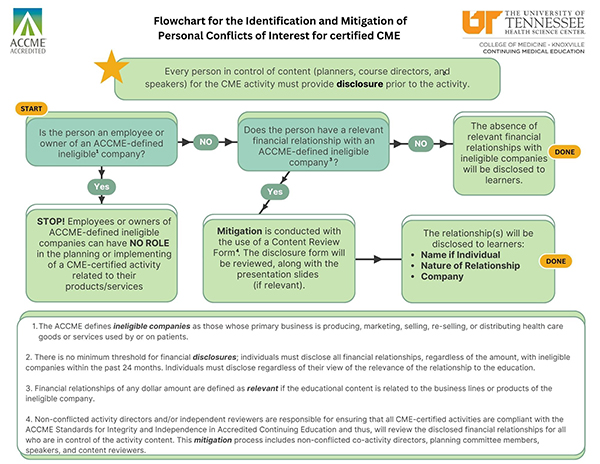
All individuals with control over CME activity content must disclose all financial relationships that they have with an ineligible company with the past 24 months.
- The ACCME defines ineligible companies as "those whose primary business is producing, marketing, selling, re-selling, or distributing healthcare products used by or on patients
- The ACCME defines a relevant financial relationship as a financial relationship in any amount, which occurred in the 24-month period preceding the time that the individual was asked to assume a role controlling content of the CME activity.
*Anyone refusing to disclose relevant financial relationships will not be allowed to plan or present at the activity.
Financial Obligation
The financial risk for any activity is the sole responsibility of the educational provider and not the office of CME.
Educational Grants
- The office of CME will not apply for any of these types of grants.
- If a co-provider wishes to apply for educational grants for CME activities, the CME must have a Letter of Agreement (LOA) prior to the start date of the activity.
- The source of all support from commercial interests must be disclosed to learners.
Activity Promotion
Promotional material must contain certain statements relative to CME credit and the educational program.
No wording such as “CME-certification is pending” is allowed per the ACCME. The CME must have final approval on all brochures and promotional materials prior to mailing.
Contact Us
Office of Continuing Medical Education
1924 Alcoa Highway, U94
Knoxville, Tennessee 37920
email: ContinuingEducation@utmck.edu
NOTE: All registration questions should be referred to the UT Conference Center at (865) 974-0280 or Conferences@utk.edu.

Headlines
About the UTHSC COM-Knoxville
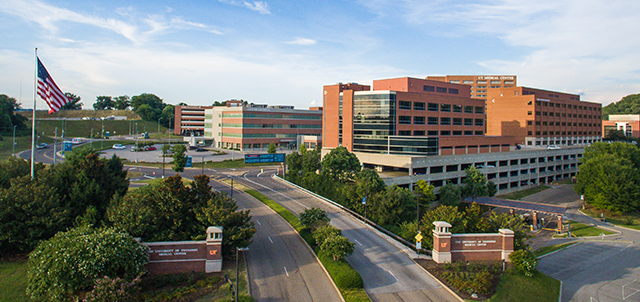
Currently, the University of Tennessee Health Science Center College of Medicine, Knoxville (UTHSC COM-Knoxville) is the sponsoring institution of 13 residency programs and 19 fellowships. The program directors of these training programs share a passion for the education, training and well-being of its GME trainees. Click here to learn about each of our departments and programs. The UTHSC COM-Knoxville is located on the University of Tennessee Medical Center's campus.

Contact Us
The University of Tennessee Health Science Center College of Medicine, Knoxville
The University of Tennessee Medical Center
1924 Alcoa Highway
Knoxville, TN 37920
Phone: 865-305-9290