The Department of Medicine
Transitional Year Program
The University of Tennessee Health Science Center College of Medicine, Knoxville (UTHSC COM-Knoxville) offers a transitional year residency program jointly sponsored by the Departments of Medicine and Family Medicine. This academically rigorous one-year program gives residents the opportunity to craft a personalized schedule in multiple departments to best meet the needs of his or her future chosen field. The majority of transitional year residents at this institution continue in the fields of radiology, dermatology, and radiation oncology. The transitional year may serve as a clinical base year for other advanced specialty programs or military service.
|
Ronnie Hamrick, MD, PD |
Madison Shadowens, MD |
|
Coleman Churitch, MD |
Nico Mascia, MD |
The Transitional Year residency is composed of thirteen 4-week blocks (Sample Schedule). Required rotations during the transitional year include two blocks of general inpatient medicine, one block of medical ICU, two blocks of ambulatory care, and one block of emergency medicine. Ambulatory Care rotation choices include Ambulatory Family Medicine and Ambulatory Surgery. Transitional residents are able to choose from a wide variety of electives from the ACGME accredited residency programs at the UTHSC COM-Knoxville. Electives are available in internal medicine/medicine subspecialities, general surgery/surgical specialties, radiology, anesthesiology, neurology, pathology, dermatology, dermatopathology, ophthalmology, radiation oncology and obstetrics and gynecology. The program director works with each resident to expose them to their eventual field of choice early in their transitional year so that residents can avail themselves of research and learning opportunities at UTHSC COM-Knoxville.
The transitional year residency emphasizes direct patient care responsibility. Transitional year assignments and opportunities are identical to those of categorical interns under the supervision of senior residents in the respective specialty fields. Residents attend Grand Rounds and the core lecture series in the department of medicine as well as didactics specific to each of their rotations. Simulation lab sessions are offered to the transitional residents for common procedures. Mentorship for academic projects is available, and sessions that emphasize the development of basic scholarly skills are part of a formal lecture series.
The emphasis this institution places on bedside teaching and development of basic clinical skills results in a transitional-year resident well prepared for many clinical pathways.
Transitional residents can take advantage of all the opportunities offered by the UTHSC COM-Knoxville and University of Tennessee Medical Center, including the University of Tennessee Center for Advanced Medical Simulation, Resident Research Day, and travel to conferences for scholarly work.
For questions regarding the transitional-year program, please contact the department.
Additionally, real-time information and updates pertinent to the Transitional Year Program can be found by following the UTHSC COM-Knoxville and the Internal Medicine Residency Program on social media.
Application Information
Please review Transitional Year Applicant Criteria. Residents are selected through the National Resident Matching Program. Applications should be submitted through the Electronic Residency Application Service (ERAS). Our residency program is listed as "University of Tennessee Medical Center at Knoxville" and our ACGME accreditation ID is: 9994700130.
News
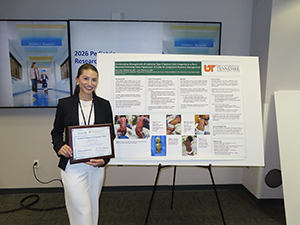
Kennedy Sabharwal, MD, Transitional Year Resident, was awarded "First Place" for her poster and presentation at the Pediatric Research Symposium, Dolly Parton Children's Hospital held on April 10, 2026.
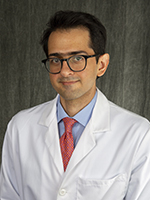
Khashayar Fattah, MD was awarded the 2025 ROI Innovation Award In addition, he was selected as ACRO Best Resident.
Contact Information
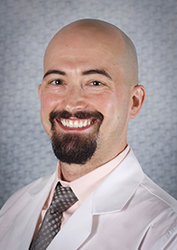
Ronnie Hamrick, MD, Program Director
Transitional Year Residency Program
Department of Medicine
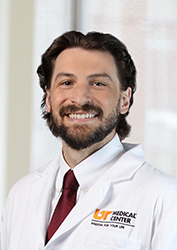
Samuel Purkey, DO, Associate Program Director
Transitional Year Residency Program
Department of Medicine
UTHSC COM-Knoxville
1924 Alcoa Highway
Knoxville, TN 37920-6999
Phone: 865-305-9340
Fax: 865-305-9144
Follow Us@UTHSCKnoxville   |
Follow Us@UTKNOXINTERNALMED |
Visit KnoxvilleLearn More About Knoxville |
